Urgent case management workflow
Research and UI Design for Complex 0-to-1 SaaS Workflow
My Role
Lead Product Designer - Full stack
Timeline
18 months
Team
14 people across 2 continents
Scope
UXR, UI Design, Prototyping, Rollout
Relocation Queue

Back
Active Cases
Active cases

Search

Unit Code
Res ID
Case Created
Task
Ownership
FLAM14
12498086

2024-09-28
Follow up 6 | Overdue 1 day
MSFM
- 2 days
NCWH66
12541404

2024-10-01
Follow up 2 | Overdue 2 days
LTR - MSFM
- 17 hrs
ORCH01e
12365627
Kayla Ryan
2024-10-03
Initiate FM
4 hrs
Today
ORCH01d
12416921
Megan Brodie
2024-10-03
Follow up | 46 minutes
7 hrs
LTR - TODAY
ORYAOC_H1U
12544348
2024-10-03
Follow up | 10 minutes
tmrw
LMFM
TXNPBC292
12463119
2024-10-03
Follow up | 43 minutes
2 days
LTR - LMFM
ORMK08
12431571
2024-10-03
Follow up 1 | 7 days
Holiday
98 days
TNGA54
12458727
Peter McHugh
2024-10-03
Follow up 1 | 47 minutes
<30 Days
4 days
TXCCED6725
12451556
2024-10-03
Follow up | 58 minutes
LTR
40 days
FLDAVRP628
12468849
Megan Brodie
2024-10-03
Follow up 3 | Overdue 10 min
30+ days
31 days
CNONCLKBRG91
12498012
2024-10-03
Follow up | 12 minutes
LTR 2+ mo
72 days

All Cases

My Cases

Case Load

Priority
10
Outcomes
68%
Reduction in urgent relocation resolution time (20 hrs → 6.5 hrs)
15K
Hours of manual data entry eliminated annually across 45,000 cases
+41%
Agents who felt work enabled efficiency — pre vs. post rollout survey
The problem
Vacasa is the largest vacation rental manager in the US. Roughly 45,000 reservations are disrupted each year and a 50-person team was managing those guest relocations with spreadsheets.
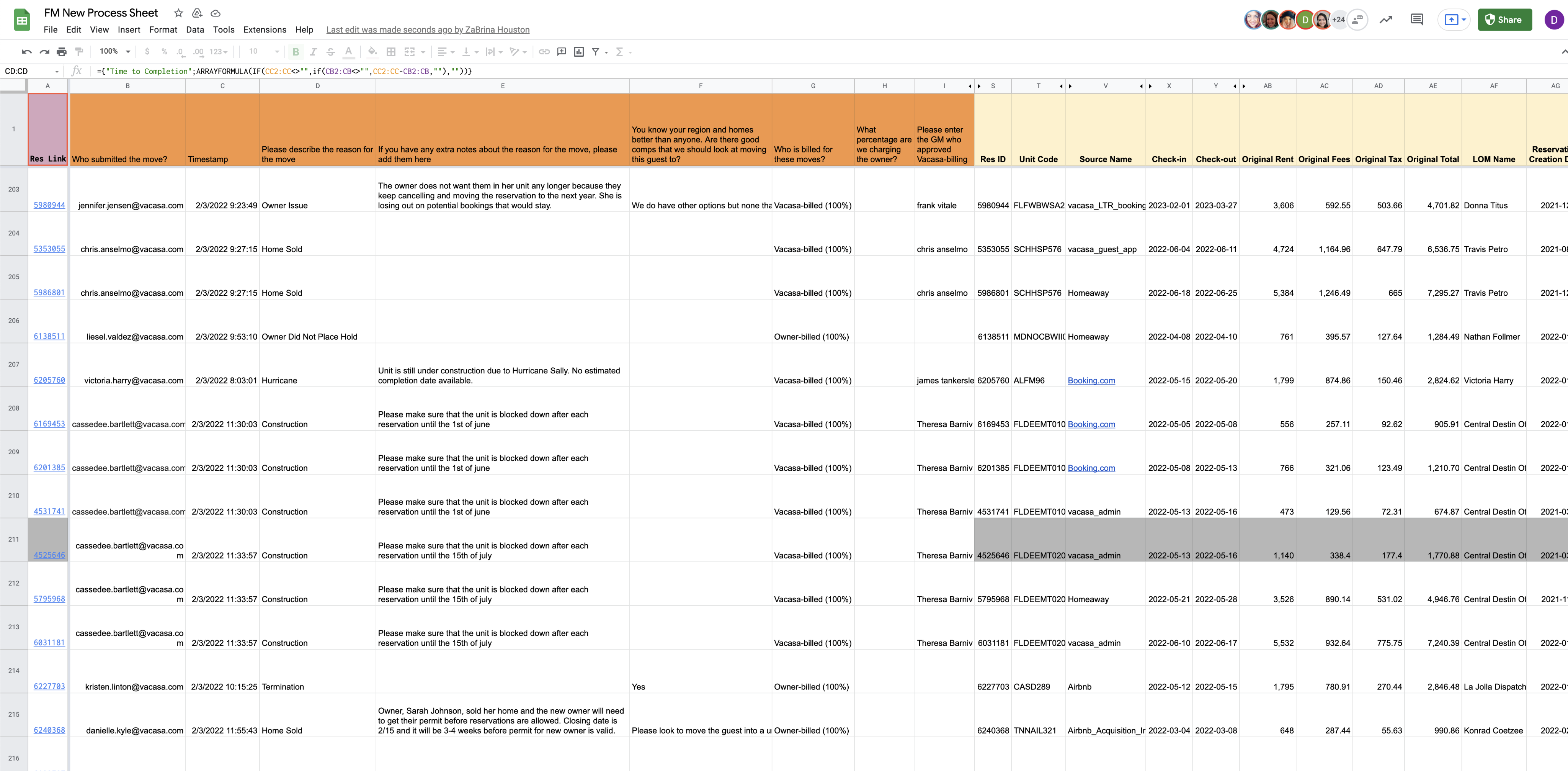
These relocations are often same-day. The team was coordinating them across Google Sheets, email inboxes, and 10–15 disconnected tools — and the most urgent cases took over 20 hours to resolve.
"Cases often stall here and we're waiting for guest reply."
— Kyle C., Relocation Agent
The journey
Jun – Jul 2022
Research & Immersion
Aug 2022 – Jan 2023
Project Pause → CRM Pivot
Feb – May 2023
UI Design & Validation
Jun – Aug 2023
PM Transitions
Phased Rollout
Sep – Dec 2023
I led this 18-month remote project from research through rollout and collaborated closely with 3 Product Managers and 10 Engineers.
Rollout & adoption
Research
I embedded with the team and onboarded like a new hire.
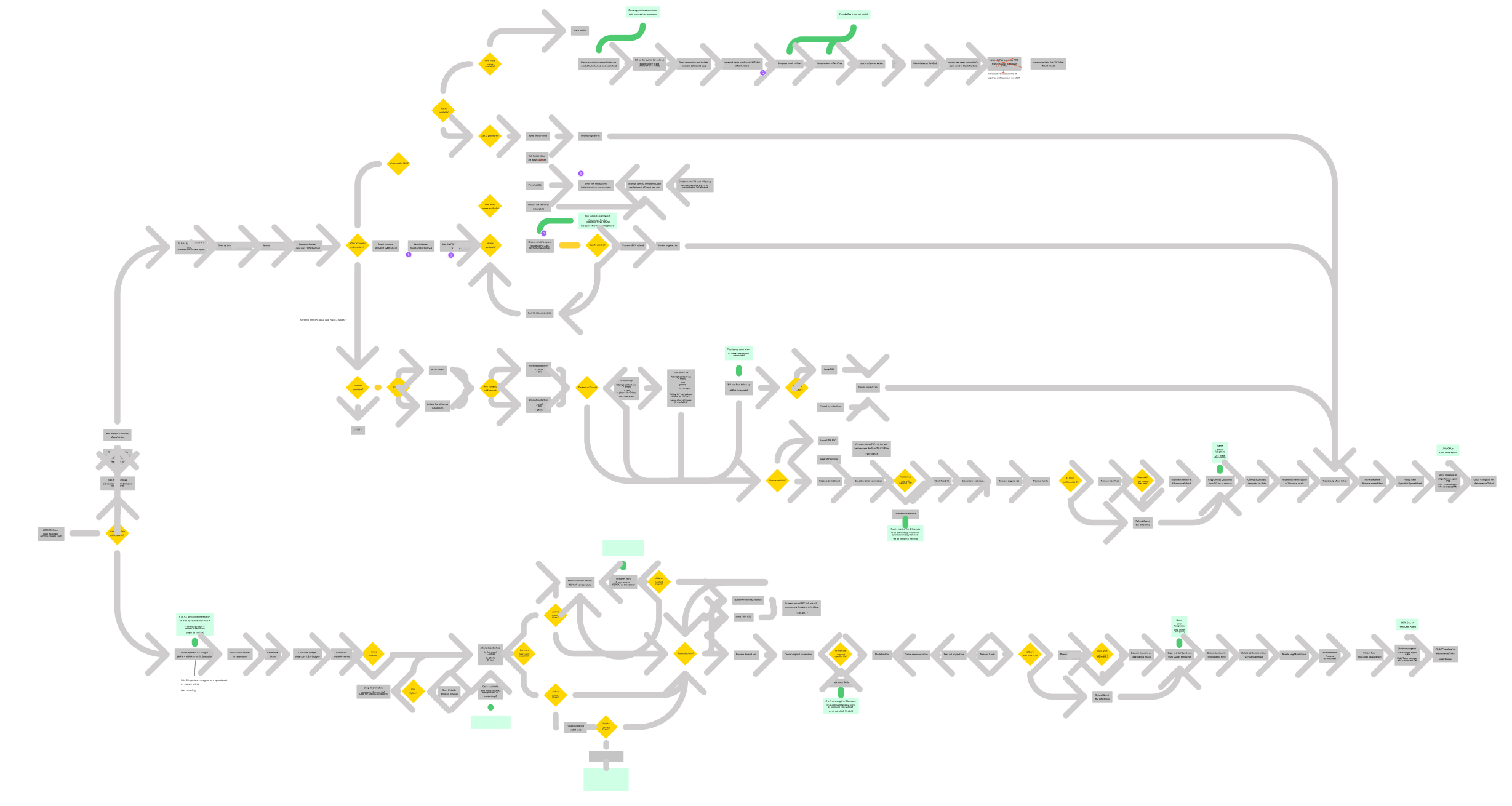
What agents described as a linear process was actually a start-stop tangle of interruptions, handoffs, and context switches. I documented all 190+ steps across 10–15 tools — the first complete process map the team had ever had.
Standard Agents (40 total)
Frontline staff juggling guests directly. Every handoff meant starting over — no shared history, no context on what had already been tried.

Senior Specialists (11 total)
Supervisors assigning cases and handling escalations. Were triaging by gut feel with no view into who was overloaded or what was falling behind.
First complete process map of the relocation workflow — exposing handoff gaps and tool fragmentation

The Strategic Pivot
A project pause revealed the right mental model.
My initial mocks explored a linear, step-by-step flow — agents shot it down immediately. Their work was too stop-start for rigid sequencing. A 6-month reassignment gave me distance, and I started seeing parallels to CRM tools like Salesforce: systems built for start-stop, multi-handoff work. That became the model.

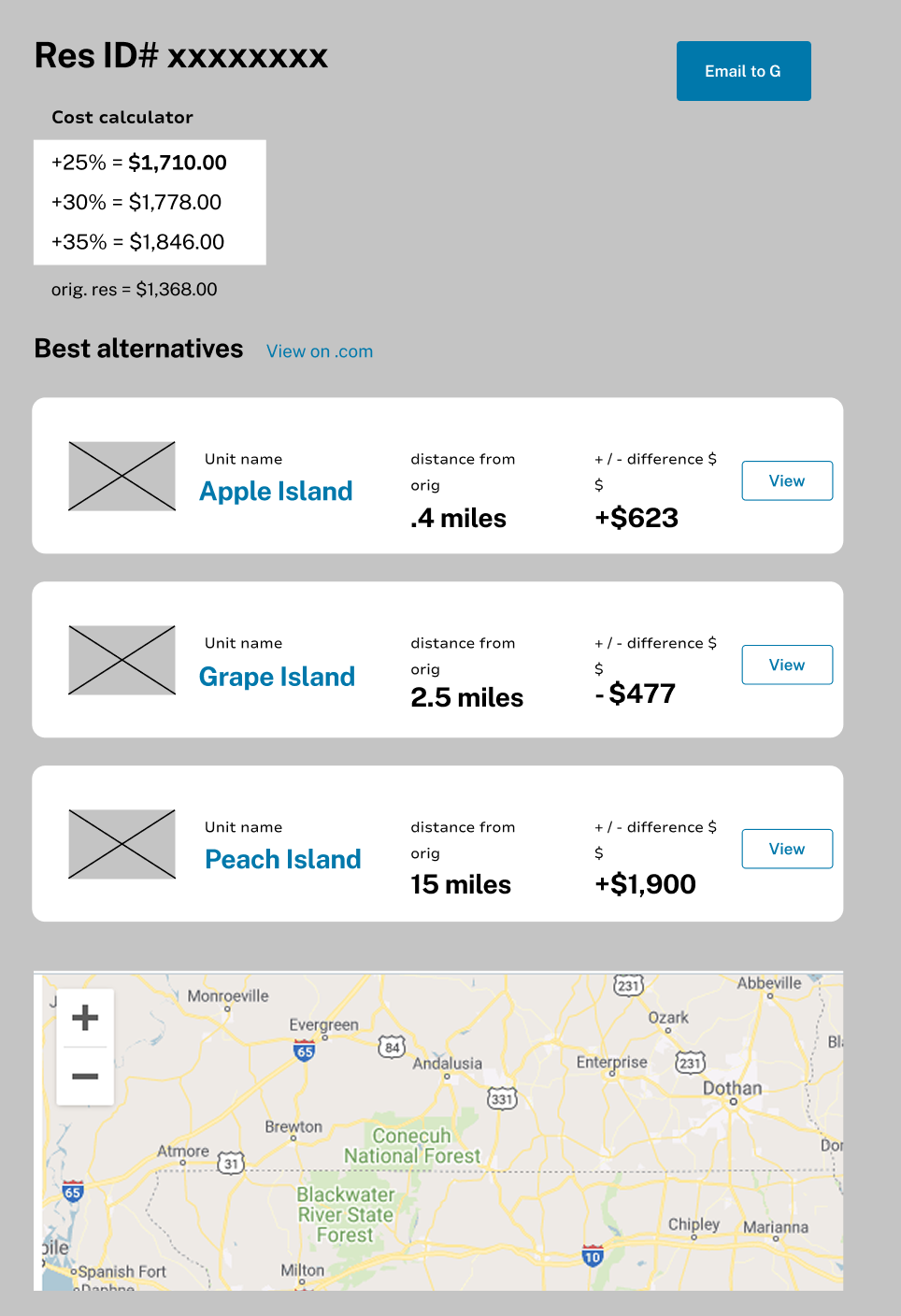
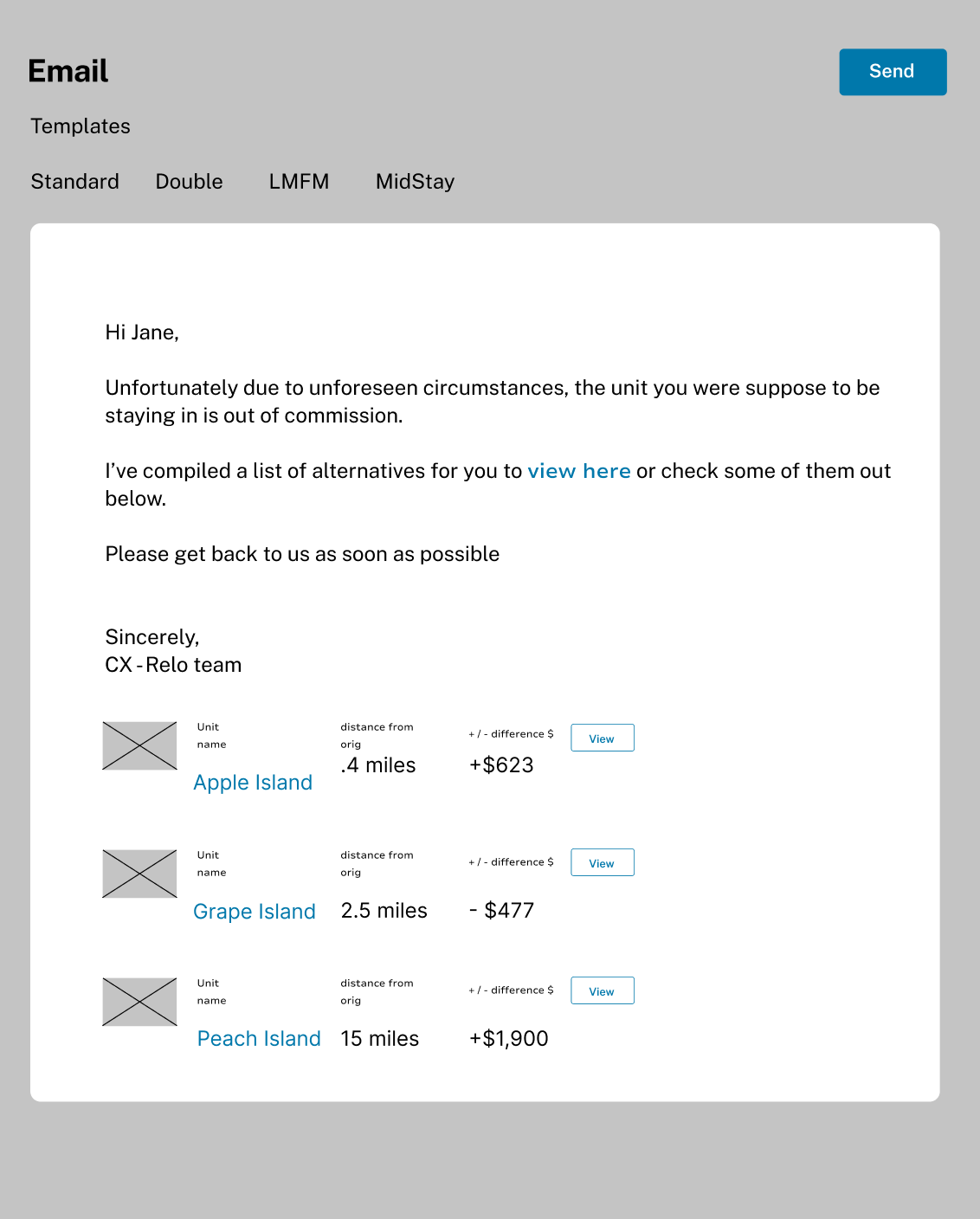
Early mocks that explored a linear, guided flow
Initial Approach: Linear Flow

Step 1

Step 2
Step 3


CRM-Inspired: Queue + Case Detail

Queue


Case Detail


Persistent cases agents could pick up, pause, resume
Rigid sequencing couldn't handle stop-start reality
Interface Design
I redesigned the workflow into four connected phases.
Each phase targeted a distinct failure mode. Together they transformed a fragmented collection of tools into a coherent case management system.
01
Mobile intake
Agents were retyping data into spreadsheets at case start — a source of 15,000+ hours of manual work annually. I designed mobile intake forms that auto-populated case records, eliminating transcription errors before agents ever touched a case.
02
Prioritized queue
Supervisors were triaging by gut feel with no view into the backlog. I embedded urgency logic directly into the queue so the highest-priority cases always surfaced first.
03
04
Case detail
Financial wrap-up
Agents lost all context at every handoff — starting over each time they picked up someone else's case. I designed persistent case records with activity logs so anyone could pick up cold.
Mobile intake form for field agents
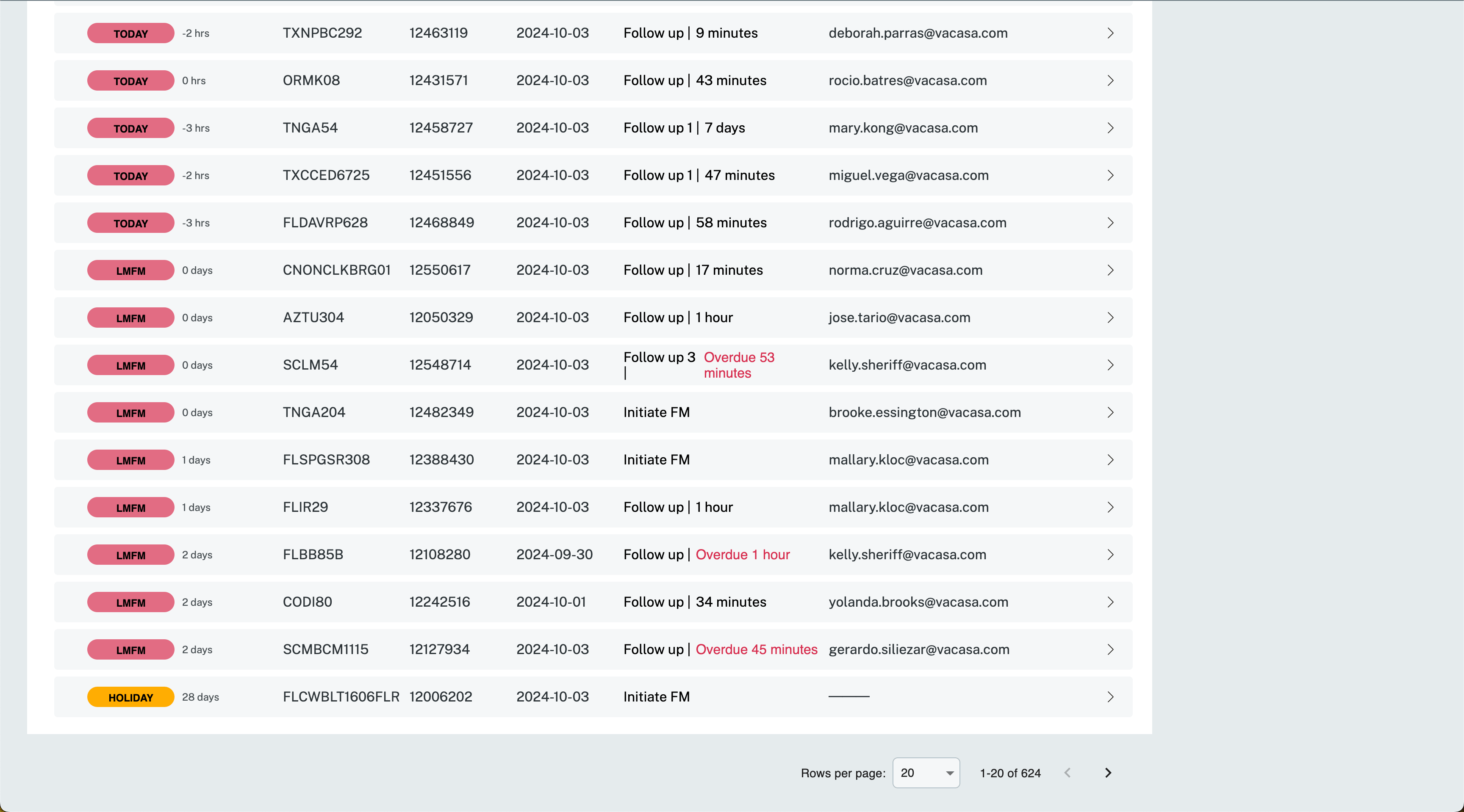
Prioritized case queue with urgency logic
Case detail page with full context
Wrap up with financial reporting
Maintaining Momentum
Three PMs, one six-month pause, and a product that still shipped.
The project lost its first PM when designs were 90% complete. Detailed prototypes, research artifacts, and strong relationships with the Relocation Team kept progress intact through the transition.
During beta, I discovered row pagination was capping supervisors at 20 cases of visibility at a time — a critical gap I caught before full rollout and resolved with Engineering by adding column sorting.
My Rollout observation
Outcomes
Within 6 weeks of rollout, the numbers proved it worked.
Time-to-complete dropped dramatically across all case types. The most urgent cases — guests checking in the same day — saw a 68% reduction.
Checking In 24–72 hrs
13.5 hrs
10.5 hrs
22% reduction in resolution time
Checking In Today
9.7 hrs
3.6 hrs
63% reduction in resolution time
Mid-Stay Relocation
20 hrs
6.5 hrs
68% reduction in resolution time
I ran a longitudinal survey pre- and post-rollout to capture the human impact alongside the operational metrics.
Further measurements of success
+41%
"This process enables me to do my job efficiently" — agents agreeing or strongly agreeing post-rollout
+36%
"This process lets me focus on the well-being of the guest" — post-rollout shift in agent focus
3x
Agents reporting near-daily work stress dropped significantly; those reporting no stress nearly tripled
Reflection
Pagination limits surfaced during beta, forcing extra engineering cycles that earlier load testing would have caught. And while I identified dashboards as valuable for Leadership, they were cut from scope. Both would have smoothed rollout and deepened trust in the system at scale.
What This Project Reinforced
Deep observation > self-reporting
Agents described a linear process. Contextual inquiry revealed the truth. The gap between the two was the entire design brief.
Distance can be a design tool
Stepping away from the project unlocked the mental model shift that made everything else possible.
Relationships carry projects through
Three PMs, two near-cancellations — the project survived because of trust built with the Relocation Team and stakeholders, not just documentation.

© 2026 Dan Rattigan

Urgent case management workflow
Research and UI Design for Complex 0-to-1 SaaS Workflow
My Role
Sole Lead Product Designer - Full stack
Timeline
18 months
Team
14 people across 2 continents
Scope
UXR, UI Design, Prototyping, Rollout
Relocation Queue

Back
Active Cases
Active cases

Search

Unit Code
Res ID
Case Created
Task
Ownership
FLAM14
12498086

2024-09-28
Follow up 6 | Overdue 1 day
MSFM
- 2 days
NCWH66
12541404

2024-10-01
Follow up 2 | Overdue 2 days
LTR - MSFM
- 17 hrs
ORCH01e
12365627
Kayla Ryan
2024-10-03
Initiate FM
4 hrs
Today
ORCH01d
12416921
Megan Brodie
2024-10-03
Follow up | 46 minutes
7 hrs
LTR - TODAY
ORYAOC_H1U
12544348
2024-10-03
Follow up | 10 minutes
tmrw
LMFM
TXNPBC292
12463119
2024-10-03
Follow up | 43 minutes
2 days
LTR - LMFM
ORMK08
12431571
2024-10-03
Follow up 1 | 7 days
Holiday
98 days
TNGA54
12458727
Peter McHugh
2024-10-03
Follow up 1 | 47 minutes
<30 Days
4 days
TXCCED6725
12451556
2024-10-03
Follow up | 58 minutes
LTR
40 days
FLDAVRP628
12468849
Megan Brodie
2024-10-03
Follow up 3 | Overdue 10 min
30+ days
31 days
CNONCLKBRG91
12498012
2024-10-03
Follow up | 12 minutes
LTR 2+ mo
72 days

All Cases

My Cases

Case Load

Priority
10
Outcomes
68%
Reduction in urgent relocation resolution time (20 hrs → 6.5 hrs)
15K
Hours of manual data entry eliminated annually across 45,000 cases
+41%
Agents who felt work enabled efficiency — pre vs. post rollout survey
The problem
Vacasa is the largest vacation rental manager in the US. Roughly 45,000 reservations are disrupted each year and a 50-person team was managing those guest relocations with spreadsheets.
These relocations are often same-day. The team was coordinating them across Google Sheets, email inboxes, and 10–15 disconnected tools — and the most urgent cases took over 20 hours to resolve.
"Cases often stall here and we're waiting for guest reply."
— Kyle C., Relocation Agent
The journey
Jun – Jul 2022
Research & Immersion
Aug 2022 – Jan 2023
Project Pause → CRM Pivot
Feb – May 2023
UI Design & Validation
Jun – Aug 2023
PM Transitions
Phased Rollout
Sep – Dec 2023
I led this 18-month remote project from research through rollout and collaborated closely with 3 Product Managers and 10 Engineers.
Research
I embedded with the team and onboarded like a new hire.
What agents described as a linear process was actually a start-stop tangle of interruptions, handoffs, and context switches. I documented all 190+ steps across 10–15 tools — the first complete process map the team had ever had. Two primary personas emerged from this work:
Standard Agents (40 total)
Frontline staff juggling guests directly. Every handoff meant starting over — no shared history, no context on what had already been tried.

Senior Specialists (11 total)
Supervisors assigning cases and handling escalations. Were triaging by gut feel with no view into who was overloaded or what was falling behind.

First complete process map of the relocation workflow — exposing handoff gaps and tool fragmentation
The Strategic Pivot
A project pause revealed the right mental model.
My initial mocks explored a linear, step-by-step flow — agents shot it down immediately. Their work was too stop-start for rigid sequencing. A 6-month reassignment gave me distance, and I started seeing parallels to CRM tools like Salesforce: systems built for start-stop, multi-handoff work. That became the model.


Early mocks that explored a linear, guided flow
Initial Approach: Linear Flow

Step 1

Step 2
Step 3


Rigid sequencing couldn't handle stop-start reality
CRM-Inspired: Queue + Case Detail

Queue


Case Detail


Persistent cases agents could pick up, pause, resume
Interface Design
I redesigned the workflow into four connected phases.
Each phase replaced a specific breakdown from research — from manual data entry, to lost context in handoffs, to error-prone financial reconciliation.
01
Mobile intake
Field staff were retyping property details into spreadsheets — 15,000+ hours of manual work annually. I designed mobile forms that auto-populated case records before agents ever touched them.
02
Prioritized queue
Supervisors were triaging by gut feel with no view into the backlog. I embedded urgency logic directly into the queue so the highest-priority cases always surfaced first.
03
Case detail
Agents lost all context at every handoff — starting over each time they picked up someone else's case. I designed persistent case records with activity logs so anyone could pick up cold.
04
Financial wrap-up
Closing a case meant reconciling costs across multiple systems — slow and error-prone. I automated the financial summary and reporting so agents could close quickly and Leadership had immediate visibility.
Mobile intake form for field agents
Prioritized case queue with urgency logic
Case detail page with full context
Wrap up with financial reporting

Maintaining Momentum
Three PMs, one six-month pause, and a product that still shipped.
The first PM left when designs were 90% complete. Detailed prototypes and strong relationships with the Relocation Team kept progress intact. When the second PM joined, business pressure threatened to kill the project — I met with stakeholders directly and negotiated continuation. That PM left too, just as rollout began. I onboarded the third quickly enough that momentum carried through to launch.
During beta, I discovered row pagination was capping supervisors at 20 cases of visibility at a time — a critical gap I caught before full rollout and resolved with Engineering by adding column sorting.
My Rollout observation
Outcomes
Within 6 weeks of rollout, the numbers proved it worked.
Time-to-complete dropped dramatically across all case types. The most urgent cases — guests checking in the same day — saw a 68% reduction.
Mid-Stay Relocation
20 hrs
6.5 hrs
68% reduction in resolution time
Checking In Today
9.7 hrs
3.6 hrs
63% reduction in resolution time
Checking In 24–72 hrs
13.5 hrs
10.5 hrs
22% reduction in resolution time
I ran a longitudinal survey to capture the human impact alongside the operational metrics.
+41%
"This process enables me to do my job efficiently" — agents agreeing or strongly agreeing post-rollout
+36%
"This process lets me focus on the well-being of the guest" — post-rollout shift in agent focus
3x
Agents reporting near-daily work stress dropped significantly; those reporting no stress nearly tripled
Further measurements of success
Reflection
Pagination limits surfaced during beta, forcing extra engineering cycles that earlier load testing would have caught. And while I identified dashboards as valuable for Leadership, they were cut from scope. Both would have smoothed rollout and deepened trust in the system at scale.
What This Project Reinforced
Deep observation > self-reporting
Agents described a linear process. Contextual inquiry revealed the truth. The gap between the two was the entire design brief.
Distance can be a design tool
Stepping away from the project unlocked the mental model shift that made everything else possible.
Relationships carry projects through instability
Three PMs, two near-cancellations — the project survived because of trust built with the Relocation Team and stakeholders, not just documentation.
© 2026 Dan Rattigan